On February 13, the CDGDC and the China Professional-degree Case Center announced the results of the 2025 thematic case study approvals. After a three-level review process consisting of institutional verification and recommendation, expert group evaluation, and case expert committee review, our University successfully secured approval for four out of the six cases submitted at the maximum allowable quota for this year, setting a new record in both the number and approval rate of selected cases.
Our University’s Selected Cases in the 2025 Thematic Case Study Approval List
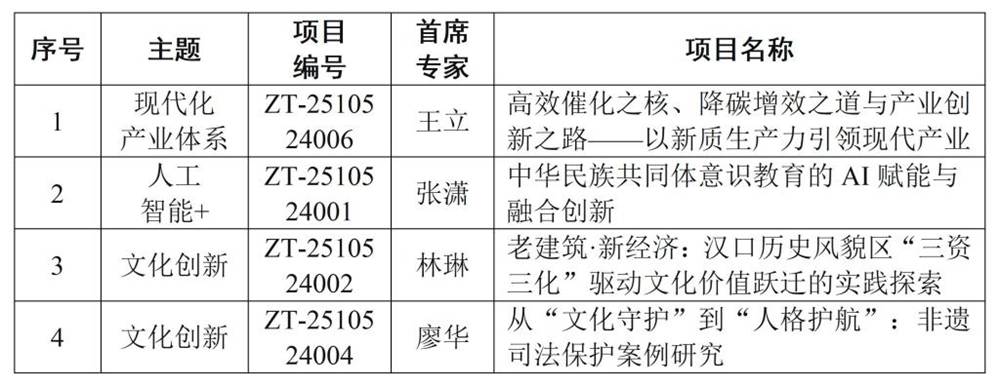
The 2025 thematic case solicitation focused on four themes: “Modern Industrial System”, “Artificial Intelligence+”, “Cultural Innovation”, and “Going Global”. A total of 2,224 projects from 440 graduate education institutions were submitted, with 906 projects from 340 institutions ultimately receiving approval. The number of approved cases at our University ranked among the top of major higher education institutions in the Wuhan and first among minzu universities nationwide.
Case-based teaching is a key measure in promoting the integration of graduate education reform and practical application. This achievement represents an important demonstration of our University’s efforts to deepen comprehensive graduate education reform and serve the “Double First-Class” initiative, fully showcasing our distinctive advantages and comprehensive strength in relevant fields. The University will continue to strengthen the cultivation and application of case resources, promote the effective transformation of approved case outcomes into high-quality teaching materials, integrate them into relevant graduate training processes, and leverage their demonstrative role to support the construction of degree programs and the comprehensive enhancement of graduate education quality.
The projectThe Core of Efficient Catalysis, the Path to Carbon Reduction and Efficiency Enhancement, and the Road to Industrial Innovation: Leading Modern Industries with New Quality Productive Forces, led by Professor Wang Li from the College of Chemistry and Materials Science as chief expert, is grounded in the national “dual carbon” strategy and the need to cultivate new quality productive forces. Focusing on efficient catalysis as a key common technology, it selects typical industrial scenarios such as greenhouse gas resource utilization, clean conversion of fossil fuels, and high-value utilization of solid waste. The project systematically analyzes the core roles of catalytic material design, reaction pathway regulation, and engineering scale-up in carbon reduction, efficiency enhancement, and industrial innovation, guiding students to understand the internal logic of how technological innovation supports the construction of a modern industrial system.
The projectAI Empowerment and Integrated Innovation in Education on the Sense of Community for the Chinese Nation, led by Associate Professor Zhang Xiao from the School of Computer Science as chief expert, closely follows the national strategy of “forging a strong sense of community for the Chinese nation” and the “AI+ Education” action direction, focusing on the urgent need for digital transformation in ideological and political education. Through interdisciplinary integration, it establishes the dual objectives of “technology empowerment + value guidance”, integrating multiple technologies such as AI corpus construction and domain-specific large model development. This achieves a paradigm innovation from theoretical indoctrination to intelligent interaction, advancing ideological and political education from knowledge transmission to meaning construction. The case emphasizes practicality and interdisciplinary integration, aiming to enhance students' emotional identification and rational understanding of the concept of the community for the Chinese nation, providing a replicable digital solution for ideological and political education at minzu universities.
The projectOld Buildings, New Economy: A Practical Exploration of Cultural Value Transformation Driven by “Assetization of State-Owned Resources, Securitization of State-Owned Assets, and Leveraging of State-Owned Funds” in the Hankou Historic District, led by Associate Professor Lin Lin from the School of Economics as chief expert, focuses on the innovative practice of value transformation in historic districts under the “Cultural Innovation” strategy. Taking the Hankou Historic District as a sample, the project systematically analyzes the mechanism of “assetization of state-owned resources, securitization of state-owned assets, and leveraging of state-owned funds” through typical cases such as the Bakoon Building. It uses digital archiving to generate “digital ID cards” for historic buildings, solidifying the asset foundation; reduces transaction costs through property rights integration, solving the problem of fragmentation; and generates stable cash flow through immersive scenes and the “first store” economy, achieving mutual empowerment of cultural and economic value. By integrating financial and digital technology resources, it constructs teaching cases on the financialization of cultural assets, blending institutional design with market-oriented operations to effectively address challenges such as scattered property rights and financing difficulties, offering replicable and scalable cutting-edge solutions for urban renewal.
The projectFrom “Cultural Safeguarding” to “Personality Protection”: A Case Study on Judicial Protection of Intangible Cultural Heritage, led by Professor Liao Hua from the Law School as chief expert, focuses on issues of online infringement of intangible cultural heritage in the Internet era, as well as damage to the personality rights of inheritors and the reputation of intangible cultural heritage. The project systematically analyzes typical cases in judicial protection, including prosecutorial support for litigation, court-issued judicial protection orders for intangible cultural heritage, and judgments affirming platform joint and several liability, addressing challenges such as inheritors’ weak litigation capacity and lengthy judicial procedures. It provides a model for governing intangible cultural heritage infringement in the Internet era and supports the modernization of cultural governance and the sustainable transmission of intangible cultural heritage.