On April 8, Professor Zhang Zehui’s research group from the School of Chemistry and Materials Science / Key Laboratory of Catalytic Conversion and Energy Materials Chemistry of the Ministry of Education published their latest findings inNature Communications, titled“Controlled Transfer-reduction of Functional Groups with Ethanol by Their Interaction Strength with the Oxygen Vacancies”(source text link:https://www.nature.com/articles/s41467-026-71308-z).
Catalytic hydrogenation serves as the cornerstone of the chemical industry, driving key transformations in the production of bulk and fine chemicals. However, precisely activating specific functional groups and achieving selective reduction remains highly challenging. The “hydrogen borrowing” strategy allows the direct use of widely available and stable alcohols as hydrogen sources, enabling selective reduction and construction of functional groups under catalytic conditions. The team has previously prepared a series of metal oxide catalysts for the selective construction of C=N and N=N bonds via hydrogen transfer reduction of nitro compounds (Nat. Commun.,2025, 16, 12963;Research,2025, 8, 0993;Angew. Chem. Int. Ed.,2024, 63, e202317339.). Nevertheless, the selective reduction of a broader range of functional groups, such as alkynyl groups and sulfoxides, remains difficult to achieve. On this basis, the research team prepared a catalyst consisting of molybdenum oxide nanoparticles supported on nitrogen-doped carbon material (Mo/CN-600), which was applied to the catalytic transfer‑hydrogenation of pyridine-N‑oxides, sulfoxides, nitro compounds, and alkynes using alcohols as hydrogen donors in a controlled manner, yielding the corresponding sulfides, pyridines, amines, and alkenes with yields of 91‑99%. The method was also applied to the synthesis of actual drug molecules. This work provides a new approach for the green and precise transformation of complex molecules.
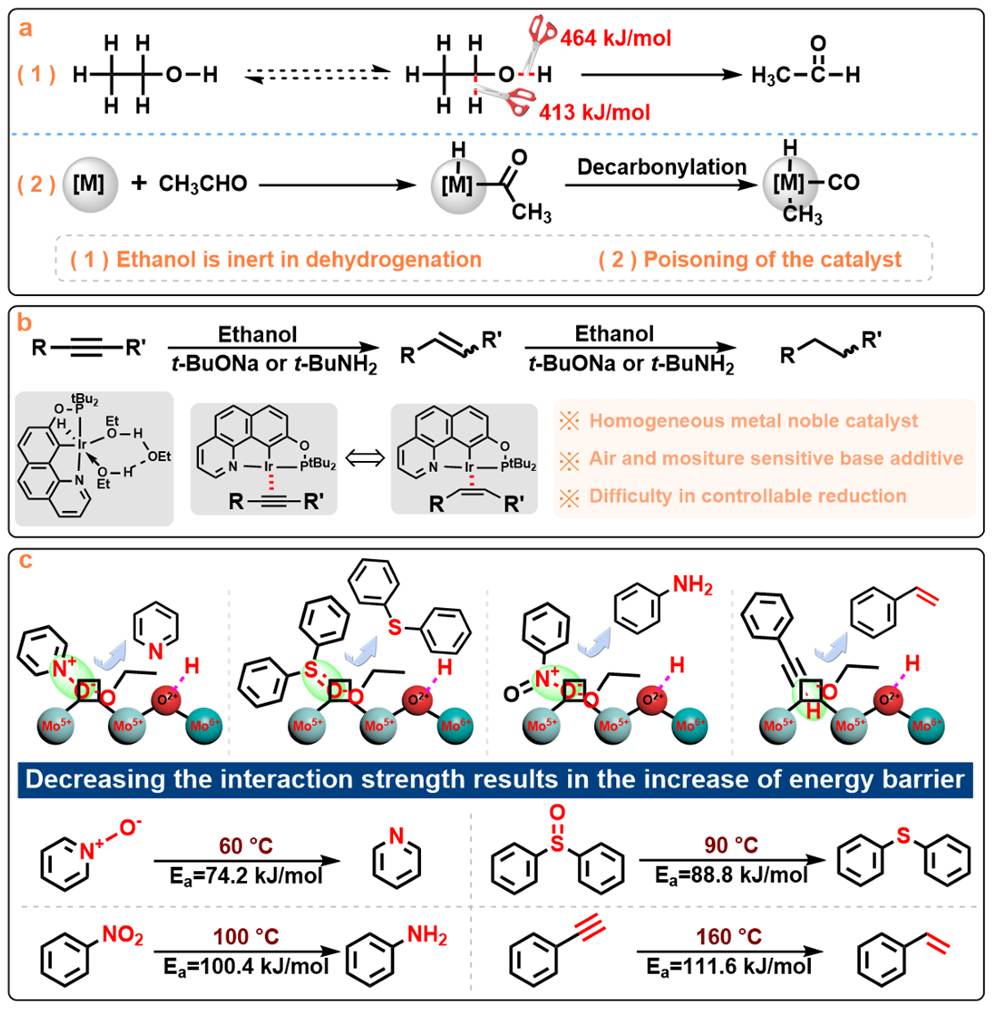
Challenges in Ethanol-based Hydrogen Transfer Reactions and the Strategy of this Study.(Photo by Zhou Peng)
Supported by continuous funding from the National Key Research and Development Program (key special projects), the National Science Fund for Excellent Young Scholars, National Natural Science Foundation of China - General Project, the Hubei Provincial Outstanding Youth Fund, and other projects, Professor Zhang Zehui’s (FRSC) research group has been working on the design of novel catalytic reaction systems guided by the concept of green chemistry, conducting research in renewable biomass energy chemistry, green organic synthesis, and heterogeneous catalysis. In recent years, the team has published a series of significant research outcomes in domestic and international journals including Nat. Commun., Sci. Adv., Chem, J. Am. Chem. Soc., Angew. Chem. Int. Ed., Adv. Mater., and Chem. Soc. Rev., establishing substantial influence in the fields of biomass catalytic conversion and green chemistry.