The research team led by Professors Liu Jikai and Chen Heping at the School of Pharmaceutical Science has long focused on the discovery of bioactive natural products and the elucidation of their biosynthetic mechanisms. Recently, the team has made new advances in the biosynthesis of fungal meroterpenoids. On June 15, the research findings were published inOrganic Letters, a Nature Index journal and a Category 1 Top Journal, under the title “Divergent Biosynthetic Routes Encoded by a Single Gene Cluster in Shikimate-Derived Fungal Meroterpenoid Biosynthesis”.
Associate Professors Li Xinyang and Ai Honglian, along with doctoral student Wang Qingyuan, are the co-first authors of the paper. Associate Professor Chen Heping and Professor Liu Jikai are the co-corresponding authors. South-Central Minzu University is the sole affiliation. Link to the paper:https://doi.org/10.1021/acs.orglett.6c02165.
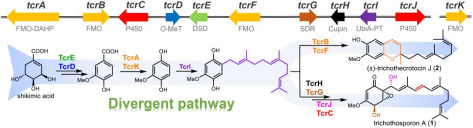
Biosynthetic Gene Cluster and Metabolic Pathways. (Photo by the School of Pharmaceutical Science)
Meroterpenoids are a class of secondary metabolites generated through the combination of the mevalonate pathway with other biochemical pathways. They are characterized by diverse skeletal structures and potent biological activities. Among them, the epoxycyclohexenone and 2H‑benzopyran types represent two meroterpenoid subclasses with markedly distinct skeletal architectures, and their biosynthetic mechanisms and complete metabolic pathways in fungi remain unclear. By integrating a suite of techniques including heterologous expression in fungi, CRISPR-Cas9-mediated gene knockout, in vitro enzymatic assays, precursor-directed biosynthesis, chemical synthesis, and molecular dynamics simulations, the team fully elucidated the functions of 10 genes within the tcr gene cluster derived from the fungus Trichothecium crotocinigenum LC36. The cluster encodes a pathway that originates from a shikimate precursor and, via a common farnesylated intermediate, branches into two entirely distinct downstream routes, leading to the production of the structurally divergent cis‑ECH-type compound trichothosporon A and the 2H‑benzopyran-type compound (±)-trichothecroton J. This study not only reveals a classic example of a single gene cluster encoding branched pathways that produce two structurally distinct natural products, but also uncovers the cofactor‑dependent substrate specificity of the ketoreductase TcrG. These findings provide important insights into the enzymatic diversity and skeletal diversification mechanisms of fungal meroterpenoid biosynthesis, and lay the groundwork for the scalable production of lead compounds.