On June 26–27, the Second Annual Conference on Disaster Anthropology was held at SCMU. The conference was hosted by the School of Ethnology and Sociology, and co-organized by the NEAC Belt and Road Country and Regional Studies Center (the Silk Road Studies Center), the Office of Development Planning and Discipline Construction, and the Center for Western Borderland Governance and Border Security Studies.
Over 50 experts and scholars from leading universities and research institutions gathered for the event, including Peking University, Fudan University, Renmin University of China, Nanjing University, Sun Yat-sen University, Yunnan University, Minzu University of China, Southern University of Science and Technology, the Yunnan Academy of Social Sciences, as well as Seoul National University and Hong Kong Shue Yan University. Scholars from diverse disciplines, including anthropology, ethnology, sociology, history, literature, and emergency management, engaged in in-depth interdisciplinary discussions around the central theme “Warnings from Heaven and Earth: Human Understanding, Perception, and Response to Disasters”, exploring pathways for the localized development of disaster anthropology in China.
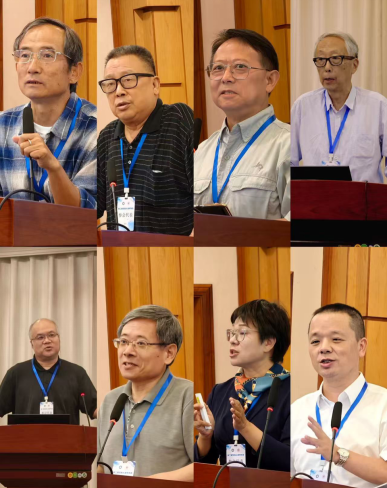
Keynote Speeches at the Conference. (Photo by Yang Liyu)
The opening ceremony was presided over by Chen Xiangjun, Dean of the School of Ethnology and Sociology at SCMU. Professor Peng Wenbin of Sichuan Normal University delivered a keynote address titledDisaster Anthropology Research in a Period of Transition and Its Prospects. He systematically reviewed the discipline’s development since the 2008 Wenchuan earthquake across three phases, i.e., foundation, expansion, and transition, and affirmed the pioneering contributions of successive committees in organizing academic conferences, journal development, major research projects, and talent cultivation. He noted that the discipline is now entering a new phase of transition grounded in the principle of “putting people and their lives above anything else”. Future research will incorporate historical, disaster history, and environmental history perspectives to extend the temporal dimension, and will adopt the “Global South” framework to expand comparative research, with a particular focus on three key regions: the Lancang-Mekong River Basin, the northwestern pastoral areas, and maritime regions. The discipline will integrate multiple pathways, including anthropology, ethnology, sociology, emergency management, geology, and hydrology, to build an independent knowledge system for Chinese disaster anthropology encompassing theory, methodology, discourse, and values, within the frameworks of “the community for the Chinese nation, the community with a shared future for neighboring countries, and the community with a shared future for mankind”, with the goal of establishing an East Asian model for Global South disaster studies.
The conference featured 8 keynote sessions and 4 parallel forums, with discussions centered on theoretical reflection and methodological innovation in disaster anthropology, disaster governance, post-disaster reconstruction and social resilience, and historical societies’ perception of and response mechanisms to disasters. Young scholars and seasoned experts engaged in robust exchanges, generating a wealth of research insights with both theoretical value and practical relevance.
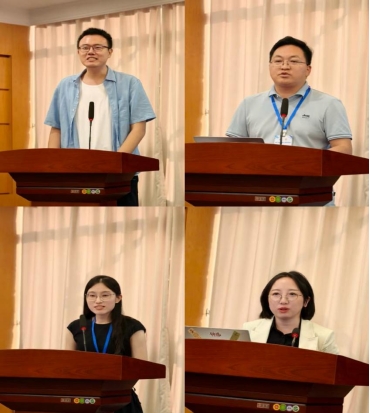
A Delegate to a Parallel Forum Delivers a Speech. (Photo by Yang Chunhao)
Experts at the conference reached a consensus: Chinese disaster anthropology in the new era has officially entered a new phase of transition toward compound and cross-border risk research. Going forward, the discipline will continue to adhere to the fundamental principle of “putting people and their lives above anything else”, leveraging the humanities to strengthen the nation’s disaster prevention and mitigation framework, and contributing Chinese academic solutions to global disaster governance.