On July 12, the Academic Symposium on Spatial Econometrics and Spatial Statistics in the Era of Artificial Intelligence, together with the 2026 Peking University Graduate Summer School on “Frontiers of Spatial Econometrics”, took place at SCMU. Co‑sponsored by the School of Government of Peking University, the School of Economics of SCMUand the Regional Science Associationof China, the event drew more than one hundred experts and scholars from over 20 universities and research institutes including Peking University, Wuhan University and Renmin University of China. The opening ceremony was presided over by Guo Cong, Party Secretary of the School of Economics of SCMU.
Ma Yutang, Member of the Standing Committee of the SCMU Party Committee and Vice‑President, attended the opening ceremony and delivered an address. He extended a warm welcome to scholars from across the country for gathering on campus to explore academic frontiers, and expressed sincere gratitude to experts from all sectors for their long‑term support for SCMU’s disciplinary development. He noted that SCMU would take this conference as an opportunity, leverage on‑campus research platforms, and promote joint research efforts with universities and enterprises. It will advance the construction of standardized laboratories and the development of proprietary spatial‑econometrics software, so that spatial‑quantitative research can contribute to high‑quality regional development.
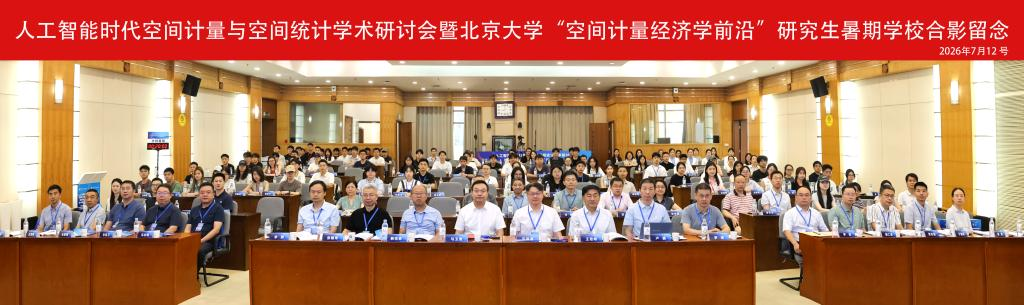
Group photo taken at the opening ceremony. Photo by the School of Economics
Centering on independent software development, the conference officially released two key industry outputs:Standards for the Construction of Spatial‑Econometrics LaboratoriesandInitiative for Proprietary‑Intellectual‑Property Spatial‑Econometrics and Spatial‑Statistics Software. Li Bo, Dean of the School of Economics of SCMU, gave a comprehensive interpretation of core contents of the standards, while Professor Shen Tiyan from the School of Government of Peking University read out the full text of the initiative.
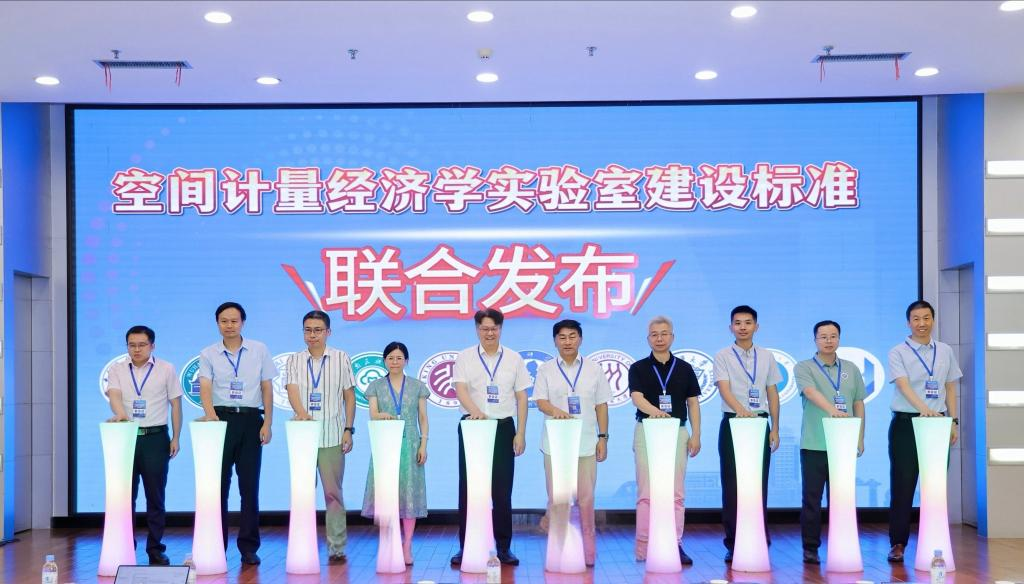
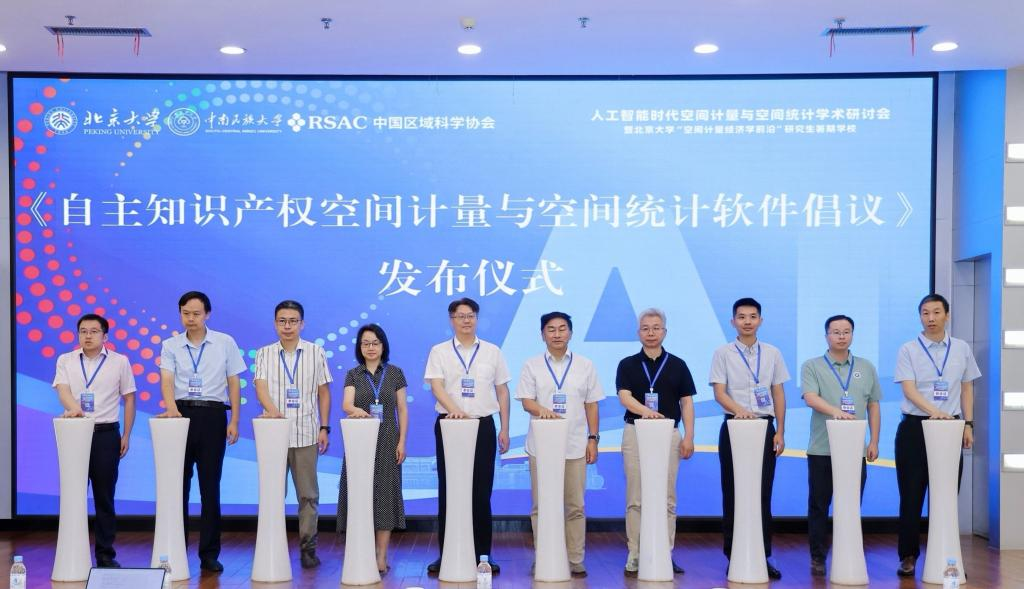
Release ceremony. Photo by the School of Economics
Subsequently, on behalf of the School of Economics of our university andBaltamatica(Chongqing) Technology Co., Ltd. respectively, Li Bo and LuTiao signed an industry‑university‑research cooperation agreement on spatial‑econometrics software.
Renowned scholars delivered keynote reports in sequence, including Wang Jinfeng, Chief Research Fellow for Spatial Analysis at the Institute of Geographic Sciences and Natural Resources Research, Chinese Academy of Sciences; Professor Zhang Yaojun from Renmin University of China; Professor Li Xi from Wuhan University; Associate Professor Lu Xiao from Peking University; Associate Professor Yu Hanchen from Chongqing University; and Professor Li Bo from our university. The experts shared their latest research findings and ideas for practical transformation covering topics such as Geo‑Detector, construction of national‑scale spatial‑intelligent systems, application of nighttime‑light remote sensing, deployment of proprietary‑IP software, computation of multiscale geographically weighted regression, and text‑analysis paradigms for AI for Social Science.
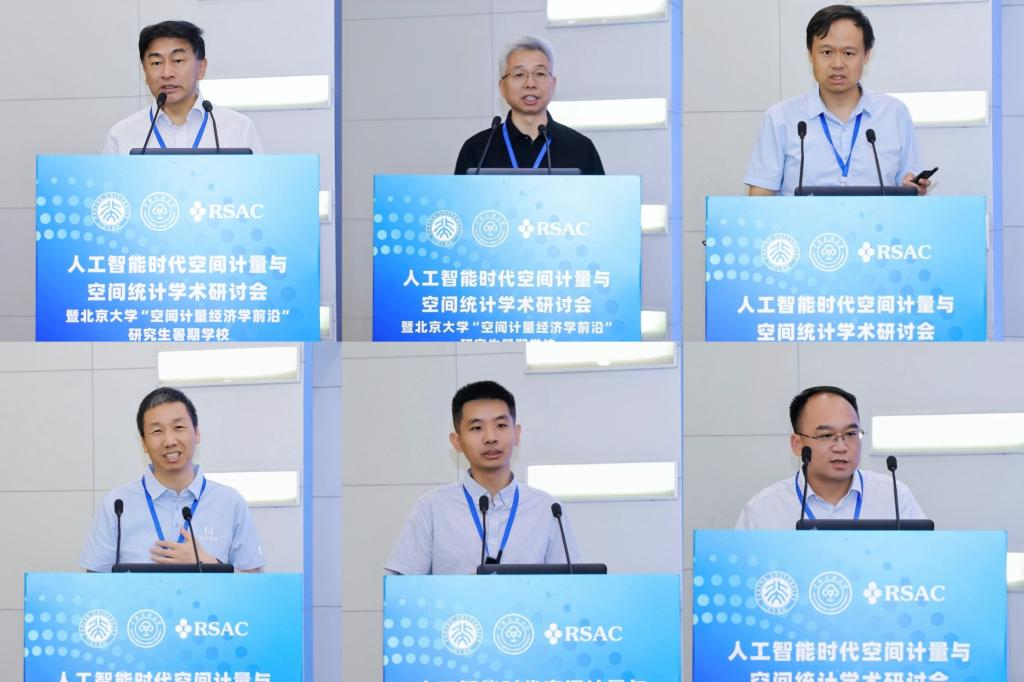
Scholar delivering a keynote report. Photo by the School of Economics
The symposium also featured a special panel dialogue on education in spatial econometrics and spatial statistics in the AI era. Scholars including Professor Chen Renjun from Central China Normal University, Professor Ma Nan from SCMU, Associate Professor Zhang Zhiqiang from Nankai University and Associate Professor Yu Hanchen engaged in in‑depth exchanges focusing on curriculum reform for spatial‑econometrics courses amid lively on‑site discussions.
In the afternoon of July 12, six parallel sub‑forums were held simultaneously. In‑depth discussions revolved around core themes: spatially coordinated governance for green and low carbon transition; spatial coupling and evolution of energy ecosystem; spatial spillovers of digital economy driven regional innovation; spatial interaction mechanisms for agricultural green development; industrial spatial restructuring in comprehensive rural revitalization; and spatial heterogeneity together with risk prevention and control in public governance.
A special “Journal‑Reader Face‑to‑Face” session was arranged for the symposium. Representatives from multiple journals were present, including Research on Technical Economy and Management,Journal of Shanxi University of Finance and Economics,On Economic Problems,Economic Review, andJournal of South-Central University for Nationalities (Humanities and Social Sciences). They answered questions for young scholars, facilitated efficient public ation of high‑quality spatial econometrics related research outcomes, and continuously fostered young research talent for the discipline.
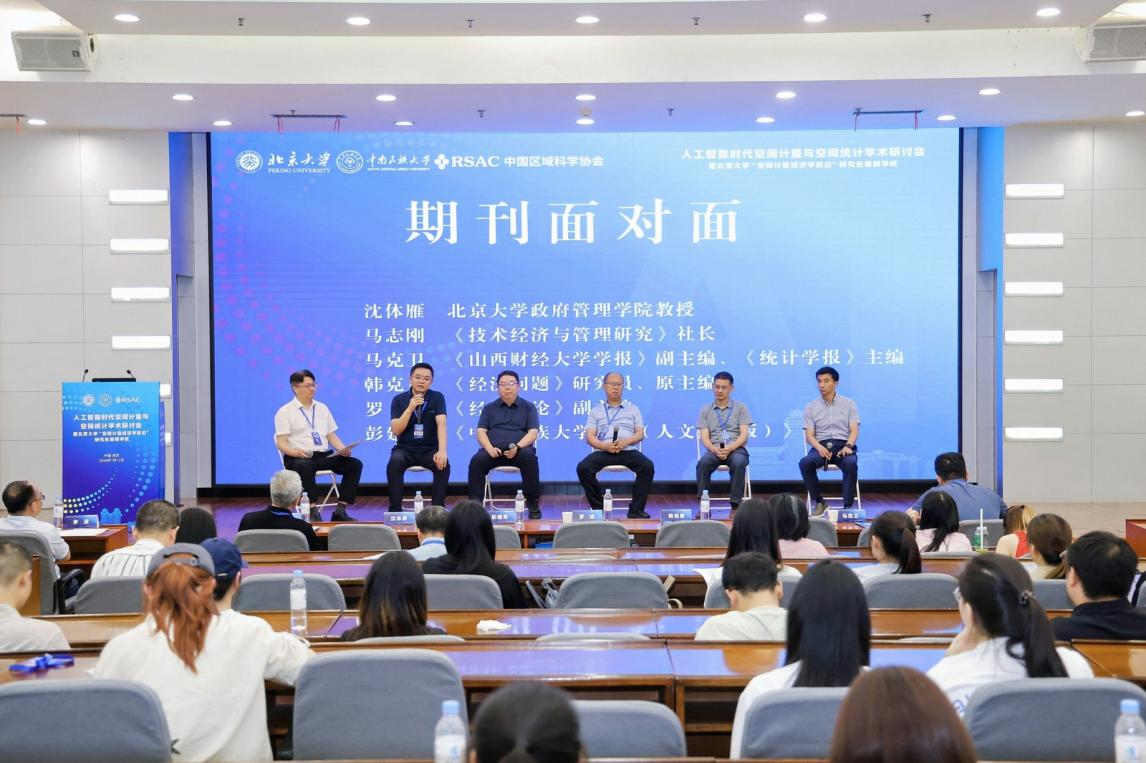
Journal‑reader face‑to‑face session. Photo by the School of Economics
As reported, the 2026 Peking University Graduate Summer School on “Frontiers of Spatial Econometrics” ran from July 13 to 16 at our university. Targeting young faculty as well as master’s and doctoral students at home and abroad, the training programme covers multiple spatially‑oriented interdisciplinary subjects including economics, sociology, demography, geography and management. It serves as a highly‑influential and benchmark high‑level academic training platform in the field.
Editor‑in‑charge: Liu Qiong Reviewed by: Lei Changsheng Uploaded by: Liu Hong Release Date: July16, 2026