On October 7, the research group led by Associate Professor Zhang Li, part of Professor Yu Guanghui's team at the College of Life Sciences, published a research paper entitledRationally optimized split crRNA-based CRISPR/Cas12a platform for amplification-free miRNA detection(link:https://doi.org/10.1016/j.bios.2026.119313) in the internationally renowned journalBiosensors and Bioelectronics(IF 10.5, JCR Q1). The paper reports the team's latest progress in molecular diagnostics using the novel gene-editing nuclease CRISPR/Cas12a. SCMU is the first-listed affiliation, and Cha Shaozhen, a master's student at the College of Life Sciences, is the paper's first author.
Through the rational design and optimization of split crRNAs, the study established a highly sensitive miRNA detection platform that requires no nucleic acid amplification, offering a new approach to the optimized design of CRISPR/Cas12a systems and the detection of tumor-associated biomarkers.
miRNAs are an important class of non-coding RNA molecules that play key regulatory roles in the development and progression of diseases and have potential applications as biomarkers. However, their short sequences, low abundance, and high sequence similarity pose challenges to rapid, sensitive, and specific detection. Conventional miRNA detection methods generally rely on nucleic acid amplification and sophisticated instruments, making them less suitable for rapid testing. Accordingly, the development of highly sensitive miRNA detection methods that do not require nucleic acid amplification is important for biomarker analysis and molecular diagnostics.
To address these challenges, the research team developed a CRISPR/Cas12a detection strategy based on split crRNAs. By splitting the spacer sequence of the crRNA, the target miRNA, truncated crRNA, and DNA activator can assemble cooperatively to activate the trans-cleavage activity of Cas12a, enabling amplification-free miRNA detection. The research team systematically compared the effects of different crRNA splitting sites on Cas12a activity and background signals, used AlphaFold 3 to predict the three-dimensional structures of Cas12a–nucleic acid complexes with different splitting configurations, analyzed the relative positions of protein functional domains and the conformational features of the catalytic center, and, based on measurements of Cas12a trans-cleavage activity, explored the potential structural basis by which crRNA splitting sites regulate Cas12a activity, providing a theoretical reference for the rational design of split crRNAs.
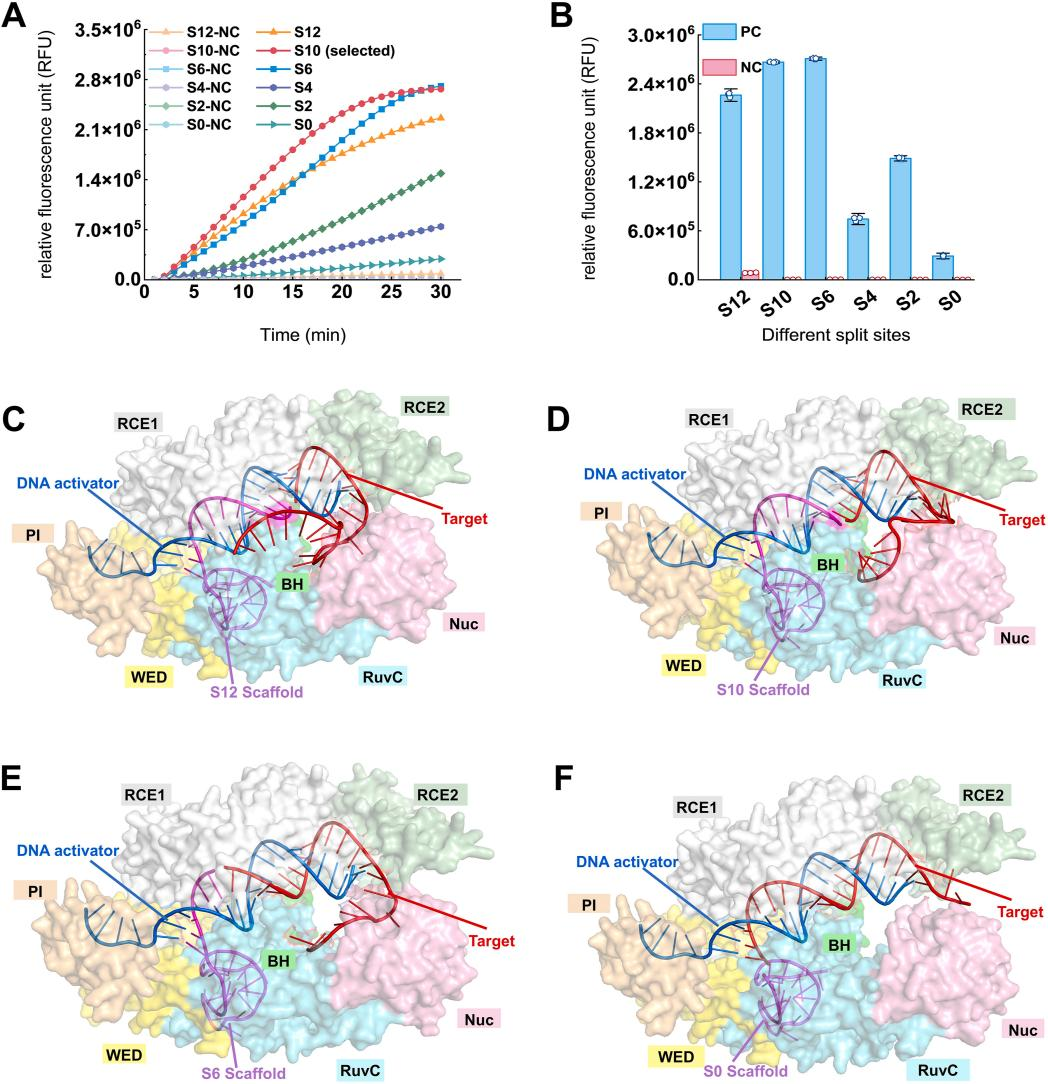
Effects of crRNA Splitting Sites on the CRISPR/Cas12a System. Photo by the College of Life Sciences
On this basis, the team further optimized the structure of the DNA activator, the proportions of reaction components, and the reaction conditions, and established detection systems for miR-155 and miR-10b (two breast cancer-associated miRNAs), achieving detection limits of 68 fM and 98 fM, respectively. The method demonstrated good detection specificity, enabled simultaneous screening for two targets in a single reaction, and supported fluorescence-based visualization. Spike-in experiments using serum matrices further validated its detection performance in complex biological sample environments.
By combining protein structure prediction with experimental validation, this study established a link between split crRNA design, the structural features of Cas12a complexes, and detection performance, offering a new approach to understanding the regulatory mechanisms of RNA-responsive CRISPR/Cas12a systems and optimizing their design.
Editor-in-charge: Liu Qiong Reviewed by: Lei Changsheng Uploaded by: Ma Bobo Release Date: October 19, 2026